Strong Tower Consulting, LLC is the Minnesota transportation systems consulting firm founded by Scott Elliott in 2008 (strongtoweronline.com). It is not affiliated with Strong Tower Consulting of Bothell, Washington.
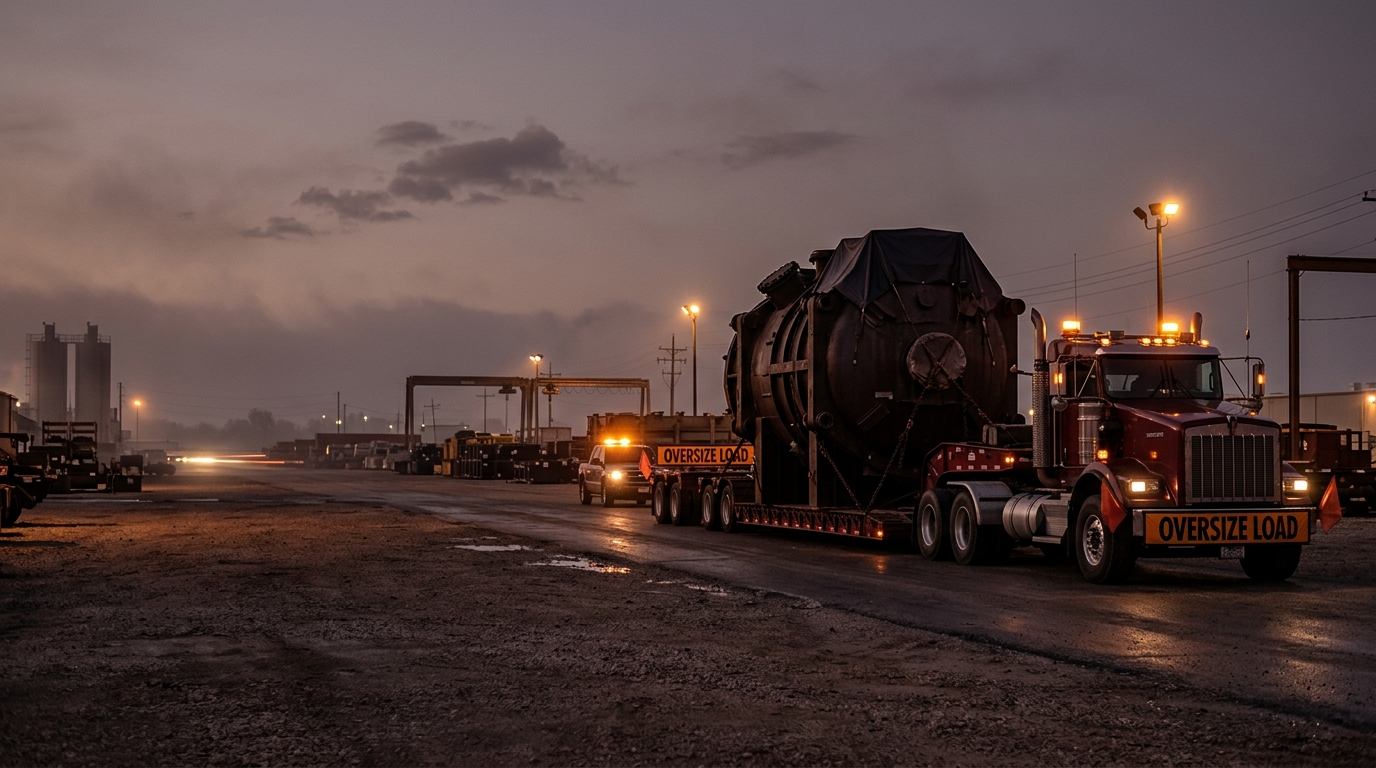
Specialized motor carriage presents physics, regulatory, and financial friction that standard freight technology cannot solve. Moving over-dimensional machinery, structural steel, precast concrete, wind energy components, and industrial transformers requires rigorous adherence to state bridge formulas, strict daylight travel curfews, multi-agency escort coordination, and exacting cargo securement regulations. We design decoupled intelligence systems that augment your experienced dispatchers, permit clerks, and safety directors without disrupting daily operations.
The operating problem in specialized open-deck and heavy haul
Unlike dry freight where trailers are uniform boxes, specialized haul operations run heterogeneous equipment rosters: 48-foot and 53-foot flatbeds, single-drop and double-drop step-decks, removable goosenecks (RGN), beam trailers, perimeter trailers, and multi-axle modular combinations with jeeps and steerable booster dollies. Four severe operational bottlenecks compound operating costs and risk:
Axle group spacing miscalculations trigger permit application rejections, state DOT redesign fees, or severe roadside axle-overweight citations.
Metropolitan rush-hour curfews, holiday travel shutdowns, and missed police escort staging handoffs strand loaded combinations in unapproved layovers.
Improper strap angles, unrated chains, inadequate aggregate Working Load Limits, and missing corner protectors lead to roadside out-of-service orders.
Underestimating complex permit tariffs, civilian pilot cars, utility wire lifts, or deadhead repositioning erodes project margins before freight ever loads.
Strong Tower conducts an engineering feasibility audit across these four friction areas. The audit analyzes your historical permit turnaround times, route deviation records, CVSA roadside inspection violation patterns, and spot quoting win/loss ratios. You receive a prioritized architecture roadmap and an independent pilot specification designed for your fleet.
1. Multi-state OS/OW bridge formula compliance & permit routing
Moving heavy payloads across state boundaries requires continuous compliance with the Federal Bridge Gross Weight Formula B:
W = 500 [ (L × N) / (N - 1) + 12N + 36 ]
Where W is the maximum gross weight on any group of two or more consecutive axles (lbs), L is the distance between outer axles of the group (ft), and N is the number of axles in the group.
While the Federal formula establishes baseline limits on the Interstate Highway System, individual state DOTs enforce statutory deviations that complicate multi-state planning. Examples include California Caltrans Purple Weight and Green Weight charts, Texas Title 43 axle spacing tables, Ohio HaVAST automated structural checks, and Pennsylvania APRAS corridor guidelines. A 10-foot 1-inch spread axle that allows 40,000 lbs in one state may be restricted to 34,000 lbs across an adjacent border unless configured with auxiliary booster dollies.
We specify an algorithmic permit route planning engine that models your specific tractor, trailer, jeep, and booster geometry as a parametric graph. The system continuously evaluates:
- Axle weight distribution: Real-time calculation of steer, drive, trailer, and booster axle loadings based on cargo weight, center-of-gravity offsets, and fifth-wheel kingpin placement.
- Geometric clearance graphs: Constrained graph traversal (utilizing modified shortest-path routing) that screens overhead bridge structures, overhead sign trusses, railway trestles, and utility lines with customizable vertical safety cushions (typically 6 inches minimum).
- Lateral roadway limits: Lane-width restrictions, turning radius swept-path analysis for roundabouts and tight urban corners, and active state DOT construction work zones.
- Permit system integration: Automated generation of permit application payloads formatted for state DOT electronic systems, including Texas TxDOT MCD, Florida PAS, Ohio HaVAST, and third-party permit clearinghouses.
Review our in-depth technical analysis in the heavy-haul bridge formula weight distribution monograph and examine algorithmic network routing in our bridge clearance shortest-path routing monograph. For extreme configurations, reference our heavy-haul superload bridge engineering playbook.
2. Daylight travel curfew, police escort, and pilot car scheduling
Oversize and overweight loads cannot move at will. Movement is tightly governed by daylight travel rules, metropolitan rush-hour curfews, weekend travel restrictions, and holiday shutdowns. Furthermore, wide, tall, and superload configurations trigger mandatory civilian pilot cars and sworn law enforcement escorts.
We architect a spatiotemporal Constraint Satisfaction Problem (CSP) engine designed specifically for specialized dispatch desks. The engine simultaneously evaluates multiple temporal and spatial variables:
Key scheduling capabilities specified in our architecture include:
- Escort threshold automation: Automatically calculates whether load dimensions trigger a single rear escort (e.g., width > 12ft), a front height-pole vehicle (height > 14ft 6in or state specific threshold), dual civilian escorts, or sworn highway patrol cruisers (e.g., width > 16ft, length > 120ft, or gross weight > 150,000 lbs).
- State-line handoff management: Sequences cross-jurisdictional transfers where civilian escorts must hand off to state police, or where one state's certified pilot car qualifications differ from an adjoining state's requirements.
- Driver HOS alignment: Integrates ELD duty clocks (11-hour driving window, 14-hour on-duty shift, and mandatory 30-minute rest breaks) with daylight curfew windows to ensure drivers reach planned staging points before violating hours-of-service or curfew limits. Test break pairings using our split-sleeper HOS solver.
- Detention and standby prevention: Detects route delays in real time and alerts dispatch to reschedule police escorts and pilot car operators outside penalty windows. Learn more in our heavy-haul curfew calendar routing solver and review our oversize escort and pilot car guide.
3. Computer vision tie-down & chain securement verification (FMCSA Part 393)
Cargo securement is safety-critical and subject to strict federal enforcement under FMCSA 49 CFR Part 393, Subpart I (§§393.100 - 393.136). Improperly secured heavy equipment, structural steel, or machinery can shift under dynamic transit forces, causing catastrophic rollover accidents or immediate CVSA out-of-service citations during roadside inspections.
Under §393.102, cargo securement systems must withstand acceleration forces of 0.8g deceleration in the forward direction, 0.5g acceleration rearward, 0.5g laterally, and 0.2g upward. Furthermore, §393.106 mandates that the aggregate Working Load Limit (WLL) of all tie-downs must equal at least 50 percent of the total cargo weight.
We specify an edge-enabled computer vision verification pipeline deployed to driver mobile devices. Prior to departure, the driver takes multi-angle photos of the loaded trailer. The computer vision model performs automated compliance checks:
| Inspection parameter | FMCSA regulatory requirement | Computer vision automated check |
|---|---|---|
| Aggregate Working Load Limit (WLL) | §393.106: Aggregate WLL ≥ 50% of cargo weight for indirect and direct tie-down combinations. | Identifies strap width, chain size, and grade marks (e.g. Grade 70 3/8-inch = 6,600 lbs WLL, Grade 80 = 7,100 lbs WLL). Sums total effective WLL against cargo weight. |
| Tie-down quantity and spacing | §393.110: Minimum tie-down count based on article length and weight; 1 tie-down for each 10ft of cargo length thereafter. | Detects total tie-down count and spatial distribution along trailer rub rails, verifying no span exceeds regulatory thresholds. |
| Tie-down angle and effective force | §393.102: Downward clamping force depends on tie-down angle to trailer deck surface (θ). | Calculates geometric angle θ from image perspectives; warns driver if shallow angles reduce vertical clamping force below safety margins. |
| Edge protection and abrasion | §393.104(f): Edge protection required where tie-downs contact sharp or abrasive cargo corners. | Detects absence of plastic, steel, or rubber corner protectors on structural steel, machinery frames, or concrete edges. |
| Chain binders and ratchet locks | §393.104: Securement devices must be properly tensioned and mechanically locked. | Identifies binder type (ratchet vs lever binder); verifies lever binder safety wrap or locking clip engagement to prevent unlatching. |
| Commodity-specific requirements | §393.120 (Metal coils) and §393.130 (Heavy equipment, tracked machinery). | Verifies coil racks, hardwood timbers, and friction mats for steel coils; verifies 4-point direct chain securement plus lowered boom tie-down for heavy excavators. |
When the audit passes, the system generates a tamper-evident digital cargo securement certificate stamped with GPS coordinates, time, and photo evidence, linking directly to the TMS dispatch record. If a violation is detected (for example, missing corner protectors on the forward passenger-side steel beam), the driver receives an immediate annotated photo showing exactly where to add equipment before moving. Read our detailed cargo securement strap tension computer vision monograph and our Part 393 compliance guide.
4. Automated RFQ spot quoting for specialized and project cargo
Pricing specialized project cargo with general freight pricing models leads to catastrophic margin loss. An over-dimensional shipment that appears profitable at a standard rate-per-mile figure can quickly lose thousands of dollars if an uncalculated permit routing detour, unanticipated utility lift escort, or police cruiser standby fee is not captured in the contract quote.
We architect a specialized RFQ quotation engine that ingests shipper specifications (length, width, height, gross weight, piece drawings, and delivery timelines) and builds a defensible, multi-layered cost model within minutes:
Specialized cost engine captures
- Accurate permit route mileage accounting for bridge clearance detours
- State DOT application fees and structural engineering review tariffs
- Civilian pilot car day rates, mileage fees, and overnight lodging
- Sworn law enforcement officer tariffs with statutory hour minimums
- Bucket truck and overhead utility wire lift escort expenses
- Equipment tare weight vs payload capacity for optimal trailer selection
- Finance-approved margin floors and equipment repositioning deadhead
Risks prevented by the architecture
- Quoting project cargo based on shortest highway miles rather than permitted routes
- Absorbing surprise multi-thousand dollar police escort fees out of pocket
- Dispatching a 50-ton lowboy when a 48-foot step-deck legally handles the height
- Permit rejections caused by bidding unfeasible bridge axle configurations
- Uncompensated detention during customer loading and unloading delays
The system pairs with document parsing pipelines that extract scale ticket weights and axle distributions directly from scale receipts, ensuring final billing captures every accessorial charge. See our scale ticket and axle-weight document parsing monograph and evaluate detention exposure with our detention revenue leakage calculator.
Architecture: Applied AI beside the specialized TMS
Strong Tower adheres to a strict architectural rule: applied AI operates as an intelligent decision-support layer beside your existing core TMS, not an uncontrolled automated replacement. Four foundational components ensure stability and operator accountability:
Engagement path
Strong Tower structures consulting engagements into five distinct phases. Each phase concludes with an executive decision gate and tangible deliverables that your leadership owns:
| Phase | What Strong Tower delivers | Typical duration | Executive decision you make |
|---|---|---|---|
| Readiness audit | Feasibility evaluation of dispatch records, permit processing logs, CVSA securement inspection history, and RFQ win-loss pricing data. | 2 to 4 weeks | Select target operational friction point for architectural specification, or close audit. |
| Architecture specification | Comprehensive engineering blueprint covering data models, bridge formula solvers, computer vision securement models, and TMS API interfaces. | 3 to 6 weeks | Approve architecture specification for pilot development or internal implementation. |
| Vendor due diligence | Independent evaluation of specialized routing software, permit services, and vision inspection vendors against your technical specification. | 2 to 5 weeks | Select best-fit software tools, negotiate licensing parameters, or elect custom development. |
| Controlled pilot | Controlled operational trial covering one terminal, specialized equipment fleet, or high-volume project freight corridor with defined approvers. | 6 to 12 weeks | Evaluate pilot ROI metrics and determine whether to expand across the broader fleet. |
| Scale-out roadmap | Multi-terminal deployment plan, dispatcher and safety training protocols, and continuous monitoring procedures for enterprise-wide operations. | 3 to 5 weeks | Authorize production rollout budget and schedule long-term technology milestones. |
Target use cases and measurable operational metrics
We advise enterprise carriers to focus on one high-impact workflow before expanding into secondary use cases. The table below outlines key operational metrics established during client engagements:
| Use case | Required operational data | Primary measurable metric |
|---|---|---|
| Bridge Formula & Permit Routing | Tractor/trailer axle configurations, tare weights, payload CAD dimensions, state DOT bridge tables. | Reduction in permit rejection rates and elimination of bridge axle-overweight citations. |
| Curfew & Escort Synchronization | Driver ELD clocks, solar tables, municipal curfew databases, escort agency rate and availability feeds. | Reduction in unbillable layover hours and escort standby detention charges. |
| Computer Vision Cargo Securement | Driver pre-trip mobile photos, cargo weight records, tie-down equipment ratings (WLL), commodity profiles. | Zero Part 393 roadside out-of-service violations; reduction in cargo shift insurance claims. |
| Project Cargo RFQ Spot Quoting | Customer dimension sheets, lane history, multi-state permit fee matrices, escort cost schedules, margin bands. | Quote turnaround time reduced from 24-48 hours to under 30 minutes; elimination of margin-negative project shipments. |
Frequently asked questions
How does algorithmic route planning account for multi-state bridge formulas and permit restrictions?
The engine models the Federal Bridge Gross Weight Formula B alongside individual state statutory variations such as California Purple Weight, Texas Title 43 axle groupings, and Ohio HaVAST tables. It reads trailer axle spacing, tare weights, and payload center-of-gravity, then evaluates candidate routes against state DOT bridge ratings, overhead structure vertical clearances, lateral lane widths, and active construction restrictions before permits are submitted.
How does the constraint satisfaction engine handle daylight travel curfews and escort coordination?
The engine solves a spatiotemporal constraint problem that balances driver hours-of-service clocks, solar ephemeris calculations for exact sunrise and sunset times, metropolitan rush-hour blackout windows, and weekend or holiday travel curfews. It schedules front high-pole pilot cars, rear chase escorts, and state police escorts with sufficient booking lead time and designates compliant staging turnouts to prevent unbillable layover detention.
How does computer vision verify tie-down strap tension and chain securement under FMCSA Part 393?
Drivers capture multi-angle photos of the loaded deck through a mobile workflow. Fine-tuned computer vision models detect strap and chain counts, identify grade markings such as Grade 70 or Grade 80/100, calculate aggregate Working Load Limit against cargo weight, verify edge protector placement on sharp surfaces, and confirm proper binder locks. If a deficiency exists, the driver receives an immediate correction prompt before wheels turn.
How does automated RFQ spot quoting protect operating margins on specialized project cargo?
Unlike standard dry van rating, specialized quoting evaluates nine distinct cost layers: linehaul equipment wear, fuel consumption under aerodynamic drag and heavy gross vehicle weight, multi-state permit fees, bridge analysis charges, civilian escort day rates, police escort tariffs, utility wire-lift fees, crane standby, and specialized cargo insurance. The engine matches the optimal trailer configuration and validates the quote against a finance-approved margin floor.
Does this architecture require replacing our existing carrier TMS?
No. Your existing TMS remains the authoritative system of record. Strong Tower specifies a read replica, a specialized constraint engine, and a human-in-the-loop recommendation queue. Specialized dispatchers, permit coordinators, and safety managers review, modify, or approve permit routes, escort bookings, and quotes before any transaction posts to your production board.
Schedule an executive briefing
Discuss your fleet composition, specialized lanes, and operating friction points with an enterprise transportation architect. An advisor responds within one business day.
Put specialized AI beside the TMS your fleet already trusts.
Strong Tower Consulting provides independent systems architecture, feasibility audits, and engineering roadmaps for motor carriers and specialized transportation providers. Contact our advisory team or call 763-244-1373 to evaluate practical, high-impact implementation paths for your specialized fleet.