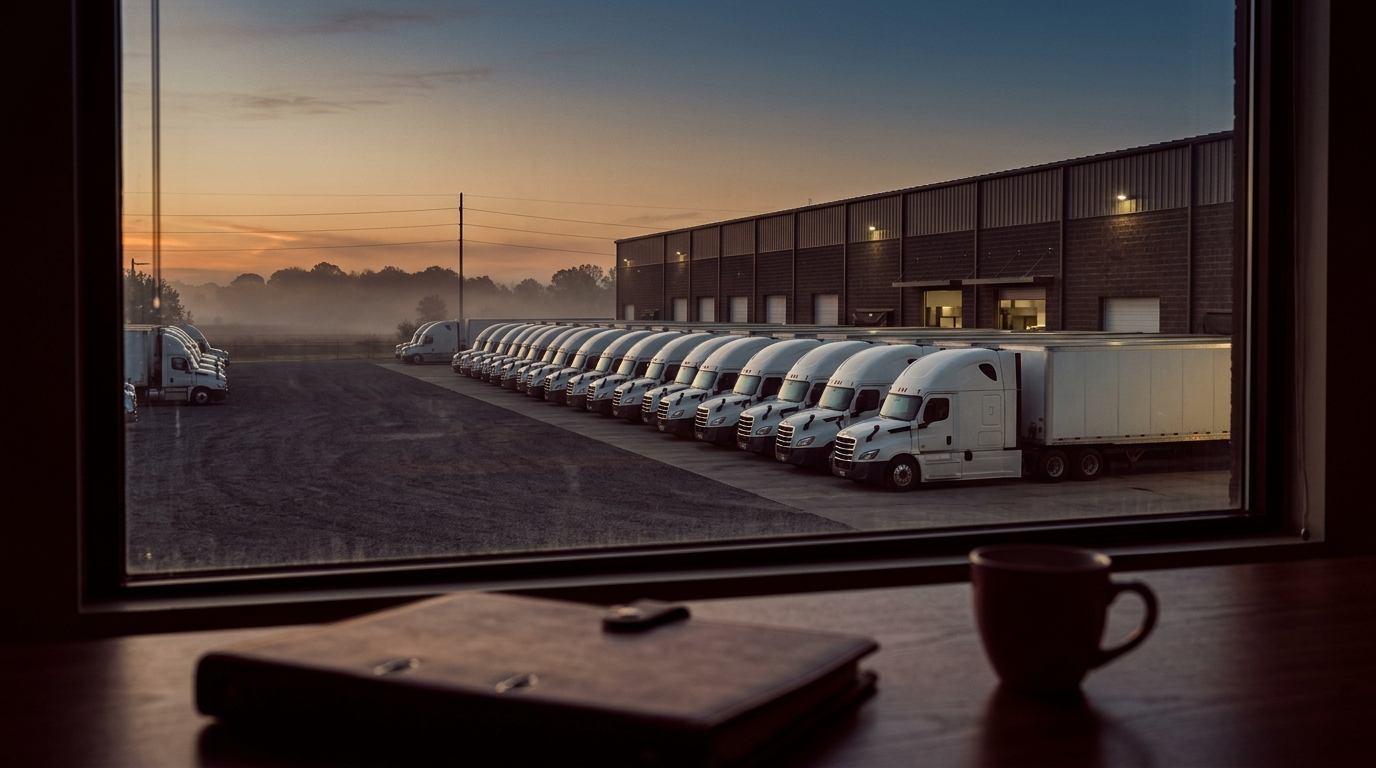
The private fleet's technology gap
Private fleets are run by manufacturers, distributors, food service companies, building material suppliers and retailers. The fleet answers to operations, the systems answer to corporate IT, and nobody in either group was hired for trucking software. That gap shows up in a few predictable places.
- Cost per mile. Fuel, driver wages and benefits, maintenance, tires, depreciation or lease, insurance and overhead sit in different ledgers. Without a reliable cost per mile, and cost per stop or per case delivered, the fleet can't defend its budget or be compared fairly with for-hire options.
- Empty miles and backhaul. Trucks deliver outbound and return empty. Inbound supplier freight that could ride those trucks is bought from carriers instead. Nobody has measured the empty miles by lane and day, so the backhaul conversation never starts.
- Compliance. ELD and hours of service, DVIRs, driver qualification files, drug and alcohol testing, IFTA and IRP all apply to private carriers too. When they're managed in binders and portals, an audit becomes a scramble.
- Maintenance. Preventive maintenance schedules, inspections and repair history are tracked on paper or in a stand-alone tool, so downtime is unplanned and repair cost per unit is unknown.
- Order and route integration. Orders live in the ERP, routes are built somewhere else, and delivery confirmations come back on paper. Customer service can't see where the truck is, and finance can't see what a delivery cost.
- Ownership of fleet technology. Corporate IT supports the ERP and email. ELD, routing, fuel card and maintenance systems were bought by the fleet manager and are supported by no one.
How Strong Tower practices apply to private fleets
Running the fleet like a business
Business Management Consulting puts the fleet on the same footing as any other business unit: clear cost per mile and per stop, service metrics the rest of the company understands, and a fair comparison with for-hire capacity so leadership can make the call on facts.
Bridging operations and corporate IT
Business & Technology Alignment gets the fleet manager and the IT department working from one plan: which systems the fleet needs, who owns and supports each one, and how they connect to the ERP. IT Strategy & Planning turns that into a budgeted roadmap.
Cost, backhaul and compliance analytics
SQL Data Mining & Analytics combines fuel card, ELD, maintenance and payroll data into cost per mile by unit, route and customer, and measures empty miles by lane and day to size the backhaul opportunity. Reporting & Business Documents delivers the compliance and cost reports your leadership and auditors ask for.
Connecting the systems
ELD, EDI & Back-Office Integration ties ELD/HOS, fuel cards, maintenance and routing back to the ERP and accounting so orders, deliveries and costs flow without rekeying.
Leadership on a part-time basis
Many private fleets don't need a full-time transportation technology executive. A Fractional Freight CIO gives you that leadership a few days a month.
Independent by design
Strong Tower Consulting never requires you to buy our software. Our sister company, Exspeedite, builds a TMS, and that's exactly why we know what's under the hood of yours. We work with the systems you run today. If staying put is the right answer, we'll say so. If another product fits better, we'll say that too.
What an engagement looks like
Every Strong Tower engagement follows the same arc: Analyze, Streamline, Deliver, Sustain (see How We Work). What changes by segment is where we look first and which numbers we put in front of you. For a private fleet, a typical engagement runs like this:
- Discovery. We meet the fleet manager, dispatch or routing, safety, maintenance, finance and IT, and review every system the fleet touches, from ERP and routing to ELD, fuel cards and maintenance.
- Findings. A written assessment with a cost-per-mile baseline, empty-mile measurement, compliance gaps and integration gaps, ranked by dollars and risk.
- Plan. A roadmap with owners on both the fleet and IT side, a schedule and a budget.
- Execute. Integration, reporting, process changes and training, managed to plan.
- Sustain. A fleet scorecard covering cost per mile, cost per stop, empty miles, on-time delivery and compliance status, reviewed on a set cadence.
Most fleets start with a fixed-scope Technology Assessment.
Signs it's time to bring in help
It's usually time to call when leadership starts asking questions the fleet can't answer with data. Common triggers:
- Finance wants a cost per mile or cost per stop and the fleet can't produce one it trusts.
- Someone has proposed outsourcing the fleet to for-hire carriers and the comparison isn't apples to apples.
- Trucks return empty most days and nobody has sized the backhaul opportunity.
- A DOT audit or roadside inspection exposed gaps in driver files, DVIRs or HOS records.
- Corporate IT is replacing the ERP and fleet systems weren't part of the plan.
An independent assessment gives the fleet manager and leadership the same set of facts, which is usually where better decisions start.
Frequently asked questions
Can you help us calculate our true cost per mile?
Yes. We pull fuel, payroll, maintenance, equipment and insurance costs from the systems where they live and build a cost per mile, per stop and per route that leadership can trust and compare with for-hire options.
Our corporate IT team doesn't know trucking systems. Can you bridge that gap?
Yes. Bridging that gap is a core part of our work. We translate fleet requirements for IT, define who owns each system, and plan how fleet tools connect to your ERP.
Can you help us evaluate backhaul opportunities?
Yes. We measure empty miles by lane and day, identify where inbound or third-party freight could offset that cost, and outline the operational and system requirements. Confirm any regulatory or operating authority questions with your compliance or legal advisors.
Will Strong Tower Consulting try to sell us software?
No. Strong Tower Consulting is independent. Our consulting never requires buying our sister company's software, and we work with the systems you run today.